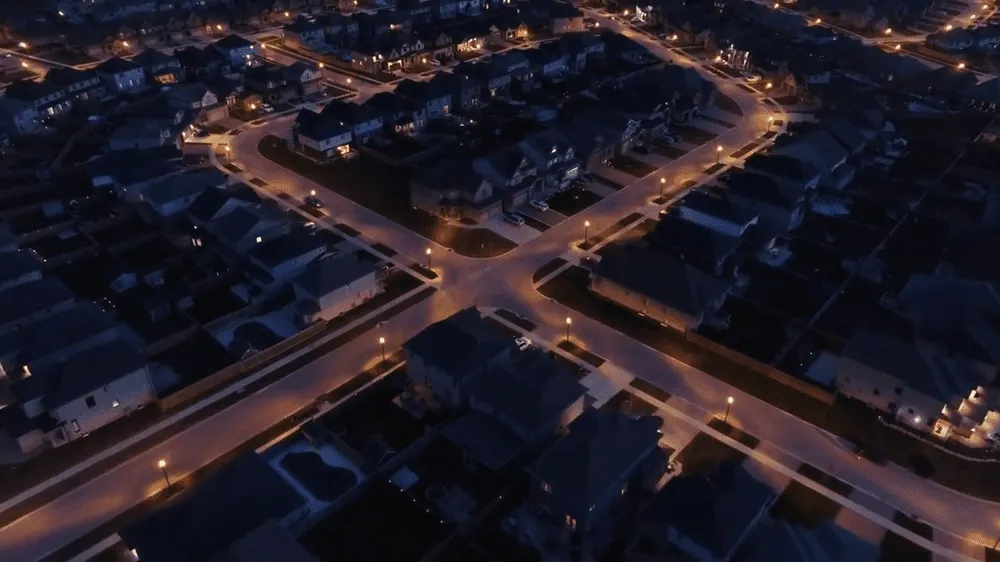
The Importance of Lighting Simulation

As a green lighting solution, commercial solar street lights are widely used in various outdoor scenarios. However, different environments like parking lots, streets, and parks have unique lighting needs. A customized solar street lighting system must meet these specific standards. Lighting simulation is crucial in the solar street light design process, allowing for virtual analysis and optimization of the lighting effects.
Overall Outdoor Brightness Planning
The brightness requirements vary significantly among different outdoor scenarios.
Parking Lots
In parking lots, to ensure the safety of vehicles and pedestrians, a uniform and appropriate brightness is needed, enabling drivers to clearly identify parking spaces, passages, and the surrounding environment.
- Through lighting simulation, the number, location, and power of solar street lights can be precisely planned based on the scale, layout of the parking lot, as well as the flow patterns of vehicles and pedestrians, achieving efficient lighting.
- For example, for multi-storey parking lots, simulation can help determine the optimal brightness settings for different floors, avoiding overly bright or dim areas.
Street Lighting
Street lighting needs to balance the visual needs of road users and traffic safety.
- Main roads require higher brightness to ensure clear visibility for drivers when vehicles are moving at high speeds.
- In contrast, in residential streets, the brightness should be appropriately reduced to create a comfortable living atmosphere.
- Simulation can combine the width and narrowness of the street, the number of bends, and the distribution of surrounding buildings to accurately layout street lights, ensuring that the road surface receives sufficient and uniform lighting, and reducing dark areas and glare.
Parks
As a recreational place, the brightness planning of a park should be integrated with the landscape.
- Trails need sufficient brightness to guide tourists, and around scenic spots, the brightness can be adjusted to highlight the landscape features.
- For example, lower-brightness street lights can be installed by the lake to create a peaceful atmosphere, while in gathering areas such as squares, the brightness can be increased to meet the activity needs.
- Simulation can design brightness plans that meet the functions of different areas according to factors such as the park's terrain and vegetation distribution.
Lighting Requirements
Customized solar street lighting systems need to meet specific lighting requirements beyond just brightness.
Color Temperature
Color temperature plays a key role in creating different lighting atmospheres.
- In street lighting, lights with a higher color temperature (such as 4000K-5000K) can provide a clear and bright visual effect, which is suitable for busy streets and helps to improve drivers' attention.
- In leisure areas such as parks, warm lights with a lower color temperature (such as 2700K-3500K) can create a more warm and comfortable atmosphere, allowing tourists to relax.
- Lighting simulation can visually display the effects of different color temperatures in specific scenarios, helping designers choose the most suitable color temperature.
Angle
The irradiation angle of street lights directly affects the lighting range and uniformity.
- In parking lots, by simulating and adjusting the irradiation angle of the lamps, the light can better cover parking spaces and passages, avoiding lighting blind spots.
- On the street, a suitable irradiation angle can ensure that the light is concentrated on the road surface, reducing light interference to surrounding buildings.
- For special landscapes in the park, such as sculptures and flower beds, unique irradiation angles can be determined through simulation to highlight the three-dimensionality and beauty of the landscapes.
Energy Management and Weather Considerations
Lighting simulation also plays a crucial role in energy management and adapting to different weather conditions.
Energy Management
By simulating the power-generation efficiency of solar panels and the energy consumption of lamps under different lighting conditions, the system configuration can be optimized.
- Ensure that, while meeting the lighting requirements, the energy-use efficiency is maximized.
- Based on the local sunshine duration and intensity, the specifications of solar panels and the capacity of batteries can be reasonably selected.
- By simulating and predicting the operation of the system under different seasons and weather conditions, the brightness and working hours of street lights can be adjusted in advance to achieve a balance between energy conservation and efficient lighting.
Weather Conditions
Simulation can help evaluate the lighting performance of solar street lighting systems under different weather conditions.
- In severe weather such as heavy rain and sandstorms, the propagation and attenuation of light can be simulated.
- Corresponding protective measures can be taken in advance to ensure that the street lights can operate stably in various environments.
- This ensures reliable lighting services to users regardless of weather conditions.
- Weather simulation helps in designing robust systems that can withstand challenging environmental conditions.
Conclusion
Lighting simulation is of undeniable importance in customized solar street lighting systems. From overall outdoor brightness planning, to specific lighting requirements such as color temperature and angle, to light-pollution control, energy management, and dealing with different weather conditions, simulation technology provides a comprehensive and scientific basis for the design and optimization of customized solar street lighting systems. By making full use of lighting-simulation technology, solar street lighting systems that better meet the needs of various outdoor scenarios can be created, achieving a perfect combination of lighting functions, environmental friendliness, and high-efficiency energy use. With the continuous development of technology, lighting simulation will play an even greater role in the solar-lighting field, promoting the industry to develop in a more intelligent and green direction.