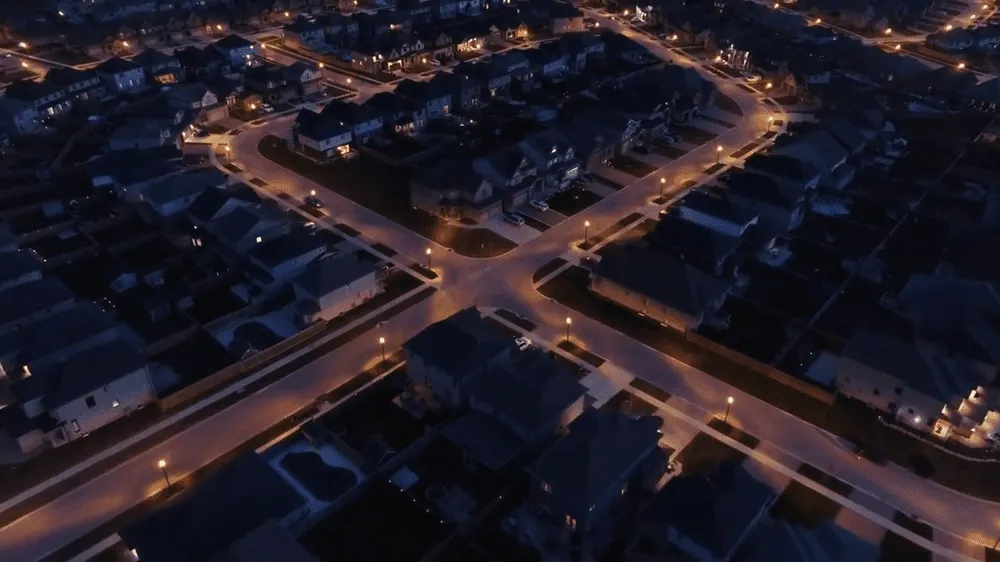
Simulated vs Actual Lighting for Solar Street Lights

In commercial solar street lights projects, it is common to find significant differences between the pre-sales lighting design created with Dialux software and the actual lighting effect after installation. This involves many complex factors, which we will analyze comprehensively below to help you minimize discrepancies in your solar street light installation.
Deviation in Solar Street Light Fixture Installation Position and Height
The installation position and height of solar street light fixtures are critical factors that can cause discrepancies between design and reality in your solar lighting system.
Incorrect Height Reference
Many people mistakenly use the pole height as the fixture height for lighting calculations for their commercial solar street lights. However, what truly determines the lighting effect is the net height of the lamp head suspended by the arm from the ground. If this is overlooked, or the height of the pole foundation is not included, it will lead to an incorrect calculation baseline.
Misjudgment of Installation Position
The actual fixture is installed at the end of the arm, and its horizontal position may differ from the pole's position. If the design uses the pole coordinates as the light source position, it will lead to errors in simulating the light's coverage and angle, thus affecting the actual lighting effect of your solar powered street lights.
Differences in Core Optical Parameters of Solar Street Light Fixtures
The optical characteristics of solar led street light fixtures can significantly impact the lighting effect, leading to deviations from the design for your solar lighting system.
IES File Does Not Match Actual Parameters
The optical performance of the actual fixture should strictly correspond to the IES file used in the design. If the actual wattage or photometric curve of the fixture deviates from the file, it will directly affect the accuracy of the light intensity and distribution simulation for your commercial solar street lights.
Inconsistent LED Chip Arrangement
If the actual arrangement of the LED chips differs from the layout on which the IES file is based, it will change the initial emission angle and distribution pattern of the light, causing the actual effect to deviate from the design specifications.
Effect of the Housing on Light Distribution
The housing refracts and scatters light. Different housing designs of your solar street light components can significantly alter the light's propagation path and intensity distribution. If this effect is not accurately considered in the simulation, deviations will occur.
Influence of the Lens on Light
The optical lens of the LED also affects the light's propagation direction and focus. If the lens parameters are not precisely considered during the design phase, the actual lighting effect of your solar led street lighting system may differ from expectations.
On-Site Environment and Measurement Errors for Solar Street Lights
The actual installation environment and measurement inaccuracies can cause significant differences between design and reality in your solar street light installation.
Inaccurate Distance Measurement When Importing Maps
If there is an error in the measurement distance when importing a map into Dialux, it will affect the scale of the entire scene layout, causing the fixture's position in the simulation to be inconsistent with the actual situation for your commercial solar street lights.
Neglect of Terrain Undulations
Dialux map simulations are usually flat, but actual roads may have slopes or undulations. This can cause discrepancies between the illuminance calculations and the real situation for your solar powered street lights.
Obstruction by Surrounding Objects
There are often obstructions such as trees or buildings around the actual installation site of your solar lighting system. If these are not considered in the design, they will block or alter the light's propagation path after installation, making the lighting effect significantly different from the simulation.
Interference from Ambient Light
Dialux designs typically assume ideal ambient light conditions. However, in real-world scenarios, ambient light sources like light from nearby shops or reflections from buildings can interfere with the street lighting, affecting the final outcome for your solar led street light system.
Long-Term Operation and System Losses in Solar Street Lights
Over time, various factors can cause the actual lighting performance of your commercial solar street lights to deviate from the initial design.
Lumen Depreciation Due to Fixture Aging
After a period of use, the luminous efficiency of a solar led street light will decrease, a phenomenon known as lumen depreciation. This results in the actual light intensity being lower than the designed value, affecting the long-term lighting performance of your solar lighting system.
Power Supply and Line Losses
Dialux focuses on optical simulation and may not fully account for power supply and line losses. In an actual solar street light installation, the cables from the power source to the fixture have resistance, causing voltage drop and power loss. This means the actual power received by the fixture is lower than the designed value, consequently reducing the light intensity.
Conclusion: Minimizing Gaps in Solar Street Light Design and Installation
Many factors, from installation position and height, core optical parameters, to on-site environmental interference and long-term operational losses, can lead to discrepancies between the pre-sales Dialux design and the actual lighting after solar street light installation. When designing and implementing commercial solar street lights projects, it is necessary to consider these factors comprehensively and meticulously. It is also important to reserve a necessary margin during the design phase (such as applying a maintenance factor), while strengthening design communication and on-site verification of the first installed light. This will help minimize the gap between the design and the actual lighting, ensuring your solar lighting system achieves the desired effect.